- SEPAWA Congress
- E
- Program
- E
- Lecture program
Lecture program
New scientific discoveries and the latest product developments from the industry find their well-earned place in our lectures at the Scientific Conference and Forum for Innovations.
14.10.2026
09:00
17:00
Auditorium
European Detergents Conference (EDC): “Synergistic Effects in Amphiphilic Systems”
EDC
| European Detergents Conference (EDC)
, “Synergistic Effects in Amphiphilic Systems”
(available in the SOFW media library after the congress)
The EDC 2026 will thematically focus on synergistic effects in systems with one or more amphiphiles and their physicochemical fundamentals. We will examine fundamental mechanisms of self-organization and seek to understand structure-property relationships, even beyond purely additive effects.
14.10.2026
09:00
09:30
Auditorium
RESOLV – a Cluster of Excellence Devoted to Boosting Product Formulation
EDC
| European Detergents Conference (EDC)
, “Synergistic Effects in Amphiphilic Systems”
(available in the SOFW media library after the congress)
Lecture Language: English
The RESOLV (Ruhr Explores Solvation) Cluster of Excellence is an interdisciplinary research project led by Ruhr University Bochum and the Technical University of Dortmund. Since 2012, approximately 200 researchers from the fields of chemistry, physics, biochemistry, and chemical engineering have been investigating the role of solvents in both reactions and formulations at the molecular level. In its third funding period (2026–2032), RESOLV will receive 43 million euros in funding from the German Research Foundation (DFG).
One of RESOLV’s three main research areas is “Stability and Homogeneity”, which investigates the physical stability of complex systems against crystallization and liquid-liquid phase separation. In particular, this area focuses on expanding the solubility limits of highly hydrophobic solutes in aqueous environments using suitable additives such as surfactants and polymeric nanocarriers.
Following an overview of RESOLV activities in general, the presentation will illustrate RESOLV’s research activities on solubilization using surfactants, which comprises molecular simulations and experimental characterization of surfactant aggregates using advanced light scattering techniques. Very recently, we succeeded in developing an analytical thermodynamic model that enables modeling of liquid-liquid demixing in aqueous surfactant solutions as well as the prediction of the critical micelle concentration within seconds. Furthermore, for the first time, this modeling approach is even able to predict the dramatic increase in the solubility of hydrophobic compounds in the presence of surfactants. In addition to that, it allows even predicting the size and shape of mixed aggregates composed of surfactants and solutes, as well as the number and even the location of solute molecules within these aggregates in very good agreement with experimental data.
14.10.2026
09:30
09:50
Auditorium
Tuning Surfactant Performance via Heteroaromatic Motifs: Linking Hydrophobicity to Interfacial Behaviour
EDC
| European Detergents Conference (EDC)
, “Synergistic Effects in Amphiphilic Systems”
(available in the SOFW media library after the congress)
Lecture Language: English
Surfactants are essential to modern life, yet their performance is still largely optimised empirically, with limited molecular-level understanding of how structure governs function. Here, we present a systematic investigation of heteroaromatic surfactants, focusing on how heteroaromatic headgroup motifs modulate amphiphilic behaviour and interfacial performance. Building on bio-derived systems such as sulfonated alkyl furoates, we test the hypothesis that heteroaromaticity alters effective hydrophobicity, thereby influencing micellisation, adsorption, and macroscopic properties.
A series of heteroaromatic surfactants, including furan-, thiophene-, and pyrrole-based alkyl sulfonates, was synthesised and systematically characterised. Key physicochemical properties, including critical micelle concentration and surface excess, were evaluated alongside application-relevant metrics such as foaming performance and Zein protein solubilisation. Across the series, clear differences in interfacial behaviour were observed, indicating that heteroaromatic structure modulates hydration, packing, and effective hydrophobicity.
To rationalise these observations, molecular dynamics simulations were employed to predict interfacial tensions and the Gibbs free energy of transfer from water to oil as a quantitative descriptor of hydrophobicity. The simulation results show strong agreement with experimental trends, demonstrating that heteroaromatic motifs systematically tune surfactant behaviour by altering hydration thermodynamics and interfacial adsorption. Together, these findings establish a direct link between molecular structure, hydrophobicity, and macroscopic performance in heteroaromatic surfactant systems.
These findings provide new insights into how molecular features influence amphiphilic self-assembly and interfacial phenomena, offering a predictive basis for surfactant design. More broadly, this work contributes to the fundamental understanding of structure–property relationships in amphiphilic systems and supports the development of next-generation surfactants with improved efficiency, mildness, and sustainability.
14.10.2026
09:50
10:10
Auditorium
Orthogonal Self‑Assembly of Biosurfactant Wormlike Micelles and a Bis‑Urea Gelator for Sustainable Rheology Modification
EDC
| European Detergents Conference (EDC)
, “Synergistic Effects in Amphiphilic Systems”
(available in the SOFW media library after the congress)
Lecture Language: English
The demand for sustainable rheology modifiers is increasing, as many conventional structuring agents are derived from fossil‑based feedstocks, show poor biodegradability, or are classified as microplastics. This motivates the development of environmentally friendly alternatives that provide robust rheological performance without relying on traditional synthetic polymers.
Microbial biosurfactants represent a promising class of renewable and biodegradable amphiphiles capable of forming wormlike micelles, which are widely used for viscosity tuning and viscoelastic modification in consumer formulations. However, wormlike micelles, even when highly entangled, ultimately display terminal flow behavior and cannot generate a true yield point—a key requirement for stabilizing heterogeneous systems such as suspensions or emulsions.
To introduce a well‑defined yield stress without resorting to non‑biodegradable polymers, low‑molecular‑weight gelators (LMWGs) offer an appealing non‑microplastic alternative. Yet surfactants are known to modulate LMWG fiber nucleation and network morphology, making mixed biosurfactant–LMWG systems difficult to design without understanding their mutual interactions.
In this study, we investigate the combined self‑assembly of mannosylerythritol lipid B (MEL‑B), a microbial biosurfactant forming wormlike micelles at low concentration, and a bis‑urea LMWG synthesized from 4,4′‑methylene diphenyl diisocyanate and L‑alaninol (MDI‑2). Using a combination of rotational rheology and diffusing wave spectroscopy microrheology (DWS), we tracked gelation kinetics, mechanical evolution, and changes in microstructural dynamics during network formation.
Our results indicate an orthogonal self‑assembly mechanism in which MDI‑2 structure develops independently of the MEL‑B micellar network. This decoupled assembly pathway enables simultaneous wormlike micelle viscoelasticity and LMWG‑induced yield behavior, providing a sustainable and non‑microplastic approach to designing tunable rheological profiles for consumer product applications.
14.10.2026
10:10
10:30
Auditorium
Biosurfactants for Forming Nanoemulsions with Triacylglycerides
EDC
| European Detergents Conference (EDC)
, “Synergistic Effects in Amphiphilic Systems”
(available in the SOFW media library after the congress)
Lecture Language: English
Oil-in-water emulsions with triacylglycerides are interesting for many applications, e.g. in cosmetics, pharmacy or foods. However, the formulation of emulsions of sufficient stability can be a major challenge and even more so when using triacylglyceride. One way to address this challenge are nanoemulsions, which have diameters of 50-400 nm and are typically kinetically rather stable. Their high surface/volume ratio gives the additional advantage of fast and controlled release of active ingredients contained in their hydrophobic core.
In this work, we studied a wider range of bioamphiphiles, such as oleate, cocoyl taurate, saponin, rhamnolipid, lecithin and Tween80 with respect to their ability to function as stabilisers for nanoemulsions. We determined the interfacial tension (IFT), as important parameter for describing solubilisation properties, against caprylic/capric triglyceride and paraffine oil as a function of surfactant concentration and for surfactant mixtures, where marked synergistic effects in IFT reduction were observed, especially for nonionic and ionic surfactant mixtures. Different preparation methods were compared, such as vortexing, ultra turrax and sonication, where sonication was found to be best for forming small and long-time stable nanoemulsions. The nanoemulsions were characterised with respect to their size and ageing behaviour by means of light scattering experiments and complementary small-angle neutron scattering (SANS). The size of stable droplets was in the range of 100 to 150 nm, little depending on surfactant type and total concentration, and basically determined by the preparation method. The main difference between the different surfactants is the surfactant/oil ratio required for forming long-time stable nanoemulsions, where in particular cocoyltaurate and rhamnolipid performed well. In summary, this means that droplet size and stability of such nanoemulsions can be tailored by appropriate choice of the preparation method and type of stabilising biosurfactant, which then leads to long-time stable nanoemulsions that could be employed in a variety of applications.
14.10.2026
10:30
11:00
Foyer 2nd Floor
Break + Scientific Poster Tour with Authors (Foyer 2nd Floor)
EDC
| European Detergents Conference (EDC)
, “Synergistic Effects in Amphiphilic Systems”
(available in the SOFW media library after the congress)
14.10.2026
11:00
11:20
Auditorium
Detergent Conjugation Decouples Drug Solubility from Antibacterial Potency
EDC
| European Detergents Conference (EDC)
, “Synergistic Effects in Amphiphilic Systems”
(available in the SOFW media library after the congress)
Lecture Language: English
Water solubility of hydrophobic drugs is pivotal for their bioavailability in pharmaceutics and cosmetics. Methods to improve drug solubility, including detergents, correlate with bacterial damage, gut dysbiosis, and common diseases. Strategies that decouple drug solubility from antibacterial potency are crucially needed. To better align detergent chemistry with consumer health, we establish a covalent solubilization strategy by connecting a single drug molecule with a detergent molecule through a covalent bond. In such a conjugate, drug and detergent will co-diffuse, enabling water solubility, independently of additional detergent molecules. For conjugation, we designed an asymmetric hybrid detergent with an independently addressable functional handle for conjugation. Compared to conventional solubilization strategies with detergent micelles, our drug-detergent conjugate exhibits surprising properties. First, the covalent solubilization strategy requires only a single detergent molecule to solubilize one drug molecule. Drug solubilization is enabled with unprecedented efficiency even at sub-micellar concentrations, as confirmed by spectroscopy, dynamic light scattering, and cryo-electron microscopy. Second, the covalent solubilization strategy can decouple drug solubility from antibacterial potency. Detergent conjugation consistently reduces drug potency against bacteria relevant to human gut health whose growth is otherwise impaired by the parent drug, as confirmed by microbiological tests. Third, the covalent solubilization strategy can endow hydrophobic drugs with unusually potent lipid bilayer permeabilizing properties. This surprising property arises from a synergy between flexible and rigid structural elements that are commonly found in detergents and drugs. It highlights the relevance of covalent solubilization for applications in which lipid membranes limit drug efficacy, as frequently observed in the development of anticancer drugs. We expect the concept can be widely extended to drugs and detergents that contain independently addressable functional groups for covalent conjugation. In summary, our findings highlight a covalent detergent solubilization strategy as a starting point for tuning bioavailability and microbiome compatibility of pharmaceutical and cosmetical formulations.
14.10.2026
11:20
11:40
Auditorium
Data‑Driven Discovery: How AI and Machine Learning Accelerate Enzyme Innovation at Novonesis
EDC
| European Detergents Conference (EDC)
, “Synergistic Effects in Amphiphilic Systems”
(available in the SOFW media library after the congress)
Lecture Language: English
At Novonesis, we are leveraging recent advances in artificial intelligence and machine learning to drive scientific decision making across product development. From AI driven enzyme discovery and metagenomic mining to ML powered expression optimization and automated data interpretation, our teams deploy models that accelerate insight generation, streamline decisions, and open innovative routes that were previously inaccessible or too complex.
At SEPAWA, we will showcase how curated and structured data enables Novonesis to train, deploy, and operationalize AI/ML solutions across industries. Through examples—ranging from predictive models guiding sequence selection to AI supported design strategies—we demonstrate how data driven approaches increase the probability of success in product development.
By the end of the presentation, we will illustrate how strong domain expertise combined with modern AI capabilities delivers faster discovery, smarter experimentation, and a more connected R&D pipeline. Join us to explore how Novonesis is transforming biosolutions innovation through data driven science.
14.10.2026
11:40
12:00
Auditorium
Towards Efficient Solubilization of Medium-Chain Triglycerides Using Mixtures of Nonionic and Anionic Surfactants
EDC
| European Detergents Conference (EDC)
, “Synergistic Effects in Amphiphilic Systems”
(available in the SOFW media library after the congress)
Lecture Language: English
High solubilization capacities and ultra-low interfacial tensions between water and oil are among the most important properties of microemulsion systems. So-called “extended surfactants” enable a very efficient solubilization of various oils, including triglycerides [1] [2]. Via systematic phase behavior studies of (pseudo-)ternary microemulsion systems, we were able to completely solubilize equal volumes of water and n-octane with only 2 wt.% of a highly efficient anionic surfactant mixture of an alkyl alkoxy sulfate (“extended surfactant”) and alkyl benzene sulfonate. Although solubilization of a medium-chain triglyceride proved somewhat less efficient compared to n-octane, it was feasible to formulate a symmetrical microemulsion using only 7 wt.% of the surfactant mixture, making it significantly more efficient than conventional alkyl polyglycol ethers [3]. However, this type of very efficient extended surfactants was only partly biobased and the alkyl benzene sulfonate was fully fossil based. To increase the content of fully biobased surfactants and to obtain at the same time a good solubilization rate for triglycerides, we combined the extended surfactant with surfactants already used in washing applications, such as a combination of nonionic alkyl polyglycol ethers and anionic alkyl benzene sulfonates and alkyl ether sulfates. Systematic investigations of the temperature-dependent phase behavior and electrical conductivity allowed us to stepwise replace the alkyl alkoxy sulfates. Thereby, we succeeded in compensating the large hydrophilicity of alkyl ether sulfates by adding small amounts of a fully biobased long-chain mono- and diglyceride mixture, resulting in an efficient solubilization of medium-chain triglycerides in microemulsions.
14.10.2026
12:15
12:45
Auditorium
The Role of Amphiphilicity in Antimicrobial Polymers
EDC
| European Detergents Conference (EDC)
, “Synergistic Effects in Amphiphilic Systems”
(available in the SOFW media library after the congress)
Lecture Language: English
Steadily increasing levels of antimicrobial resistance (AMR) are a continuous threat to our global public health. Antimicrobial polymers (APs) offer a promising solution, as their mechanism of action – the permeabilization of bacterial membranes – is unsusceptible toward AMR. However, their selectivity between is still insufficient for clinical applications.
Amphiphilicity is a central parameter determining APs activity and selectivity. Overly amphiphilic systems are usually unselective and toxic to mammalian cells. This property can be modulated by designing the polymeric architecture leading to highly selective bottle brush APs with specific aspect ratios. Too amphiphilic recipes result in irreversible unimolecular self-assembly and undesirable properties. The introduction of sugar moieties into APs sparked our curiosity as the addition of hydrophilic pendants did not have a negative influence on overall performance. Hence we questioned the necessity of amphiphilicity in APs. Advanced photo-mediated RAFT polymerization was used to create a library of APs with varying amphiphilicity and hydrogen bonding properties. Intrestingly, we found that non-amphiphilic APs can have excellent properties if cationic monomers are combined with repeats capable of strong hydrogen bonding. The absence of hydrophobic unit in turn leads to low unspecific toxicity. Non-amphiphilic APs have the unique ability to cluster on membranes, creating a supramolecular multivalence that enhances their membrane activity and aggregates bacterial cells. This effect, which only unfolds in the absence of hydrophobicity, opens new possibilities in the design of antimicrobial materials.
14.10.2026
12:45
13:15
Auditorium
Award Session: Young Scientist Awards of the GDCh Division of Detergent Chemistry
EDC
| European Detergents Conference (EDC)
, “Synergistic Effects in Amphiphilic Systems”
(available in the SOFW media library after the congress)
Lecture Language: English
14.10.2026
13:15
14:30
Auditorium
Noon Break + Scientific Poster Tour with Authors (Foyer 2nd Floor)
EDC
| European Detergents Conference (EDC)
, “Synergistic Effects in Amphiphilic Systems”
(available in the SOFW media library after the congress)
14.10.2026
14:30
15:00
Auditorium
Surfactants at Soft Interfaces: From Biolubrication to Hollywood Falling Snow
EDC
| European Detergents Conference (EDC)
, “Synergistic Effects in Amphiphilic Systems”
(available in the SOFW media library after the congress)
Lecture Language: English
Understanding the structure of soft interfaces decorated with polymers and surfactants is relevant to many biological processes and industrial applications. Recent advances have helped unravel hidden complexity at such buried soft interfaces, facilitating insights into molecular packing and nanostructure at the interfaces. The impact of such knowledge will be illustrated through several examples, including fundamental understanding of biolubrication mechanisms and eco-formulation for falling snow solutions in film industry.
14.10.2026
15:00
15:30
Auditorium
Surfactants in Harmony: Mastering Surfactant Synergies for Developing more Sustainable Formulations
EDC
| European Detergents Conference (EDC)
, “Synergistic Effects in Amphiphilic Systems”
(available in the SOFW media library after the congress)
Lecture Language: English
When formulating with surfactants, synergism is our best friend to build viscosity and to achieve a specific application performance. The “classic” and most popular synergy when it comes to forming worm-like micelles for rheology control is the one between SLES (INCI: Sodium Laureth Sulfate) and CAPB (INCI: Cocamidopropyl Betaine), combined with the addition of salt. Less well-known is why this formulation principle also has inherent benefits when it comes to foaming performance. It will be explained how the foamability of such formulations is related to the rheology (to be more specific: the normal force at high shear rates) of dilutions of the formulation. The situation pretty much changes when replacing SLES by greener, i.e. biobased surfactants or even biosurfactants, containing carboxylate instead of sulfate as anionic group. Since the synergism mentioned above ceases to work in these cases, the typical salt curve is not an option anymore. Instead, one can use a pH variation to build viscosity. It will be shown how this alternative option can be used for rheology control – and why this concept leads to challenges in terms of foaming performance. In conclusion, in the development of more sustainable and milder, sulfate-free formulations, an understanding of the physical chemistry beyond the established synergies is crucial.
14.10.2026
15:45
16:05
Auditorium
Interaction of Hydrophobically Modified Polyelectrolyte Complexes with Lipid Membranes
EDC
| European Detergents Conference (EDC)
, “Synergistic Effects in Amphiphilic Systems”
(available in the SOFW media library after the congress)
Lecture Language: English
Interactions between amphiphiles and polyelectrolyte complexes (PECs) have attracted significant attention in recent years due to their potential applications in biotechnology and medicine. Among amphiphilic systems, lipid-based assemblies such as liposomes are of special interest because they serve as model membranes and versatile carriers for bioactive molecules.
The interaction between liposomes and PECs is mainly governed by electrostatic forces, while hydrophobic interactions can additionally influence the formation and structure of the resulting complexes. Furthermore, the physicochemical properties of the polyelectrolytes contained, including their chemical constitution, charge density, distribution of charged groups, and backbone flexibility, strongly affect the structure of the PECs and affects the interaction with lipid bilayers and therefore the stability and morphology of the formed assemblies.
In this work, the interaction between PECs and lipid membranes is studied using liposomes composed of 1,2-dioleoyl-sn-glycero-3-phosphocholine (DOPC) as a model liposomal system. The PECs consist of the polycation poly(diallyldimethylammonium chloride) (PDADMAC) and the polyanion sodium poly(acrylate) (NaPAA), which are hydrophobically modified with dodecylamine to different degrees. Special attention is given to the role of the degree of hydrophobic modification, as it determines the balance between electrostatic and hydrophobic interactions.
The influence of the degree of hydrophobic modification, the mixing ratio between PECs and DOPC liposomes, and the solution pH is investigated using static and dynamic light scattering (SLS/DLS), cryogenic transmission electron microscopy (cryo-TEM), and stopped-flow techniques to gain information about the temporal evolution after mixing of PECs and liposomes. The results provide insight into the mechanisms governing PEC–lipid interactions, which is a fundamental step of importance for the potential use of PECs as delivery system. In addition, they shed light on how to design more complexly built hierarchically structure colloidal assemblies.
14.10.2026
16:05
16:25
Auditorium
Evaporation in Multicomponent Systems of Volatile Amphiphiles: Interplay of Geometry, Composition, Diffusion and Interfacial Processes
EDC
| European Detergents Conference (EDC)
, “Synergistic Effects in Amphiphilic Systems”
(available in the SOFW media library after the congress)
Lecture Language: English
This presentation will discuss the evaporation of pure water and binary and ternary mixtures of ethanol and water containing aroma molecules, focusing on the influence of composition and evaporation geometry on evaporation dynamics and interfacial adsorption-desorption processes. Experiments were conducted in a controlled environment by varying the diffusion pathways in both the bulk solution and the headspace, as well as the evaporation area.
Gravimetric measurements and maximum bubble pressure tensiometry were employed to monitor changes in the weight and composition of the solutions of volatile amphiphiles, as well as the interfacial adsorption-desorption processes, over a timescale of several days. For pure water, molecular flux towards exchange opening between the semi-closed headspace and open air is the rate-limiting step in evaporation. In ethanol–water systems (within a concentration range of 5–80 wt%), the relative and absolute evaporation rates of the components are determined by alcohol concentration, surface-to-volume ratio and liquid-phase diffusion path in a non-trivial way. By adjusting diffusion pathways in the liquid and headspace, the greatest reduction in ethanol concentration in an initially 40 wt% ethanol solution occurs in the system with the smallest surface area — a non-trivial result.
In the ethanol–geraniol mixture, the surface tension remained nearly constant during evaporation, suggesting the presence of a persistent ethanol–geraniol interfacial layer that retards geraniol desorption. The results demonstrate that in mixed solutions of volatile amphiphiles, bulk-phase evaporation is governed by coupled gas-phase transport, liquid-phase diffusion and interfacial kinetics, all of which are modulated by system geometry. These results pave the way for new approaches to studying the release of aroma molecules (e.g. fragrances), where the headspace volume and airflow influence olfactory perception.
14.10.2026
16:25
16:45
Auditorium
Phase Diagrams of Sodium Linear Alkyl Benzene Sulfonate in Ionic and Nonionic Cosurfactant Solutions
EDC
| European Detergents Conference (EDC)
, “Synergistic Effects in Amphiphilic Systems”
(available in the SOFW media library after the congress)
Lecture Language: English
Sodium alkyl benzene sulfonate (NaLAS) is one of the most commonly used synthetic anionic surfactants. It is used as detergents, emulsifiers and wetting agents in many commercial products. The main disadvantages of NaLAS are: not very good biodegradability; easy precipitation in hard water and at low temperatures. One efficient way to increase the solubility of NaLAS is to incorporate the NaLAS molecules in mixed micelles with nonionic and/or ionic surfactants. This approach was applied in our previous works [1,2] for sulfonated methyl esters (Cn-MES), which is a good alternative to NaLAS in the formulations such as laundry detergents. The boundaries of the phase diagrams are experimentally obtained at a temperature of 5 °C by measuring the solubility limits at different concentrations of surfactants, the critical micelle concentrations, the electrolytic conductivity, etc.
The good theoretical description of the phase diagrams is achieved applying the extended thermodynamic model for the phase equilibrium. The model predicts the concentrations of all components (monomers, mixed micelles, precipitates if any), the composition of mixed micelles and their electrostatic potential. As a result, the phase diagrams at low temperatures of mixed NaLAS and other surfactant (nonionic and ionic) are compared to those of С16-MES, С18-MES and their mixtures in different ratios [1,2].
The proposed general model for describing the different phases in mixtures with nonionic and ionic surfactants is convenient for predicting such complex phase diagrams and can be used for optimization of formulations of practical interest.
[1] Danov K. et al. Journal of Colloid and Interface Science 601 (2021) 474–485. https://doi.org/10.1016/j.jcis.2021.05.147
[2] Yavrukova V.et al. Journal of Colloid and Interface Science 660 (2024) 896–906. https://doi.org/10.1016/j.jcis.2024.01.127
The authors are grateful for the financial support from the Project # KP-06-М89/2 – 04.12. 2024, with the National science fund of Bulgaria (abbreviated as BG FNI – MON).
14.10.2026
16:45
17:00
Auditorium
Poster Awards + Closing
EDC
| European Detergents Conference (EDC)
, “Synergistic Effects in Amphiphilic Systems”
(available in the SOFW media library after the congress)
Lecture Language: English
14.10.2026
09:00
09:15
Room 1
Beyond Shiny and Dry Dishes: Genapol™ Pure Power for Minimized Machine Care
Forum for Innovation
| Home Care, Industrial & Institutional Cleaning: “Innovative Aspects from the Fields of Detergents and Cleaners”
, Detergents
(available in the SOFW media library after the congress)
Lecture Language: English
Growing environmental awareness, ambitious sustainability targets, and strict energy labelling requirements are driving advancements in dishwasher technology towards significantly reduced resource consumption. Modern dishwash programs respond to these demands by operating at lower water consumption and reduced temperatures, thereby continuously decreasing the environmental footprint of each wash cycle. At the same time, consumers are often using short cycle programs to save time.
These developments come with a challenge: modern dishwasher programs can lead to insufficient removal of soil, resulting in the accumulation of residues such as fatty deposits in machine compartments, most notably in the filter. These residues may negatively affect the wash performance, can reduce the lifespan of the dishwasher, and can become perceivable to consumers, who might associate this with insufficient performance of the detergent, the dishwasher, or both, negatively affecting both the detergent and the manufacturer’s brand perception.
Additional cleaning steps become necessary, resulting in increased resource consumption and maintenance effort conflicting with environmental trends and consumer expectations of low-maintenance household appliances.
This creates an opportunity for detergent producers for intelligent formulation design. With Genapol™ Pure Power, Clariant has developed an innovative rinse surfactant that leads to significantly reduced build-up of residues in the filter, enabling minimized machine care while ensuring optimal shine and drying performance. This supports longer lifetime of dishwashers and saves resources and time without compromising consumer expectations for superior and affordable results.
We look forward to presenting this innovation at the SEPAWA Congress 2026.
14.10.2026
09:15
09:30
Room 1
Microbial Dishwashing: Extending Performance Beyond the Wash Cycle with Synbiotics
Forum for Innovation
| Home Care, Industrial & Institutional Cleaning: “Innovative Aspects from the Fields of Detergents and Cleaners”
, Detergents
(available in the SOFW media library after the congress)
Lecture Language: English
Modern automatic dishwashing performance is typically assessed within the wash cycle, focusing on the removal of visible soils under standardized conditions. However, the accumulation of organic residues in machines, filters, and drainage systems remains a persistent operational challenge, particularly in professional and institutional environments.
This presentation introduces a liquid dishwashing detergent developed for professional applications, combining conventional surfactants and enzymes with a synbiotic system composed of selected microorganisms and complementary nutrients. The formulation integrates established cleaning chemistry with a biological component designed to support the breakdown of organic residues within dishwashing machines beyond the immediate wash phase.
Performance of the formulation was evaluated using standardized automatic dishwashing test methods (EN / IEC 60436), demonstrating consistent removal of common food soils such as starch, protein, and dairy residues across repeated cycles. In addition, studies on synbiotic cleaning systems in washing machines indicate that microbial activity persists in machine compartments over time and contributes to the reduction of accumulated organic residues.
The concept builds on the known enzymatic activity of spore-forming bacteria used in environmental and wastewater applications. Supporting evidence from washing machine studies indicates that such microbial systems remain active in machine environments and contribute to the gradual degradation of accumulated organic residues. By transferring these principles into dishwashing formulations, the product demonstrates how biological processes complement conventional detergency, offering an extended perspective on cleaning performance in professional and potentially consumer applications.
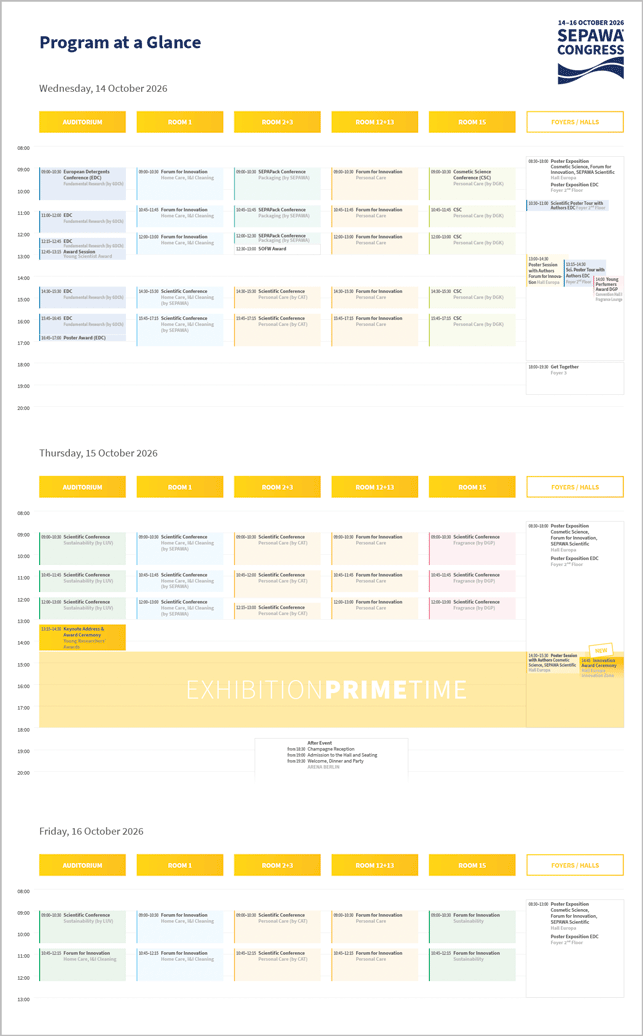
PROGRAM AT A GLANCE 2026 PDF
Let the program overview inspire you for your visit to the congress.
Download the program overview of the SEPAWA CONGRESS 2026 as a PDF file.
POCKET GUIDE PDF 2026
We are pleased to make the Pocket Guide 2026 available to you as a download.
The lecture and poster program, the exhibitor list and much more information for your visit are included.
Get your copy of the SEPAWA® CONGRESS 2026 program.